

Written by Rachel Lilburn:
I didn’t want to go on an AFS exchange to figure out my identity in the world. Truth be told, I wanted to get out of my small town, a school I was unhappy in, and see some of the world.
I thought I’d learn Spanish, and learn about Bolivia, and have some great experiences. And I did do that. But I also went home a year later more resilient, more independent and more self-aware.
When I went to Bolivia in 1994 as a 17-year-old exchange student, I only knew a handful of words in Spanish. I could count to 10, tell people my name, and ask where the toilet was. This was pre-cell phone, pre-internet – I had a pocket dictionary, and a little notebook filled with phrases that became a constant companion. The journey to my host family involved a 14 hour flight to Buenos Aires, Argentina, where we stayed overnight. The next day, another flight to Santa Cruz in the Bolivian Amazon, and a 2 day orientation camp to prepare us for life in Bolivia. I’m not sure we took in much. Everything was so new and exciting and different.
Then another flight to Sucre, the white city, sitting 2,790 m above sea level, nestled in a valley of the Andes.
I was greeted with roses at the airport, and my host family quickly realised that I didn’t understand a word they said to me in Spanish. My host mother switched to broken English, and the rest of the family just smiled at me. After sleeping for 15 hours my first night, I woke to find my nine-year-old host sister Daniela sitting at the end of my bed. She spoke no English but was very excited to have a new sister.
These days I regularly can’t find my keys, but I can still remember so clearly waking up in that bed 30 years ago, nervous, excited, and completely clueless as to what this small girl was babbling to me about.
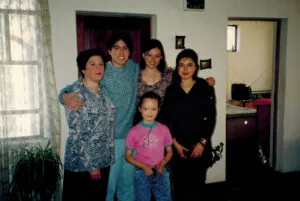
Daniela loved to talk to me. She didn’t care that I didn’t understand, and she didn’t mind me painstakingly looking up words in the dictionary, one by one.
The second morning when I woke up, my two sisters had taped Spanish labels all over the house – door, wall, telephone.
It took me around 3 months to feel like I could follow a conversation, and have some idea what was being said around me, and even start to join in.
The languages actually share many words. Animal, for example – same word, same spelling, different pronunciation.
Other words sound very similar but are very much not, as a fellow exchange student found out when she told her whole class “estoy muy embarazada” (trying to say I am so embarrassed). Unfortunately for her, embarazada means pregnant in Spanish.
Living in a house, eating family meals, sitting in a classroom for hours on end with no understanding what people are saying around me was both boring and often uncomfortable.
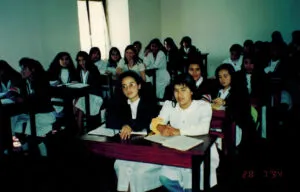
It was especially uncomfortable when I could hear my name and know the conversation was about me.
It was embarrassing when I didn’t understand, and even more embarrassing when my attempts to respond were met with laughter (laughing with me not at me, but teenage me was still embarrassed). Sometimes I’d understand that my family or friends wanted me to go somewhere with them, but not understand where I was going. Once I ended up at a funeral with a classmate. I never did work out who it was for.
As the new and exciting wore off, life fell into a familiar pattern of school and home, and time with new friends. Some days I felt very lonely, some days sad, and there were many things I missed.
Daniela continued to shadow me at home, talking. She never got bored of repeating herself. She didn’t get tired of listening to me sound out words and fix my pronunciation.
Until one day, she didn’t need to.
This is a personal story, but the experience is not unique.
An exchange removes familiarity from your life — language, routine, tradition and customs. It places you, repeatedly, in situations that are new and different.
That is where my resilience formed. Not as confidence or toughness, but as tolerance for uncertainty, for embarrassment and for being uncomfortable.
Resilience didn’t come from instruction or encouragement. It came from being uncomfortable, over and over again.
Rachel is an AFS Returnee (NZ to Bolivia). Her AFS experience sparked a lifelong love of travel and exploring other cultures. She has lived in London and Chile and now resides in the Waikato with her two sons.
You can keep reading by learning more about AFS’ programmes in Bolivia or about other AFS exchange reflections here.